Free printables4×4 · 6×6Answer keysUS Letter & A4Name & date lines
Sudoku for Kids
Two ready-to-print PDF sets for young solvers: twelve 4×4 puzzles with the digits 1–4, and twelve 6×6 puzzles with 1–6. Each sheet has lines for a name, the date and the time taken, and the answers are at the back. When a child is ready for more, the maker below builds Medium and Hard sheets in the same style.
Download the PDFs
-
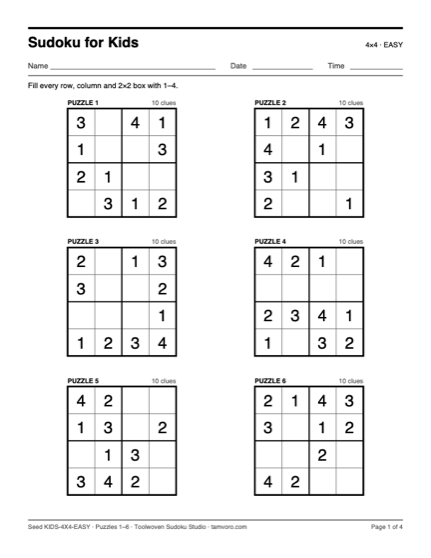
Start here
4×4 Easy · 12 puzzles
Digits 1–4 in four 2×2 boxes. Ten of the sixteen squares are filled in, so every empty square can be found by asking “which number is missing?”. Six puzzles per page make a short, satisfying session.
- Pages
- 4 (2 puzzle pages + 2 answer pages)
- Per page
- 6 puzzles
- Seed
KIDS-4X4-EASY
-
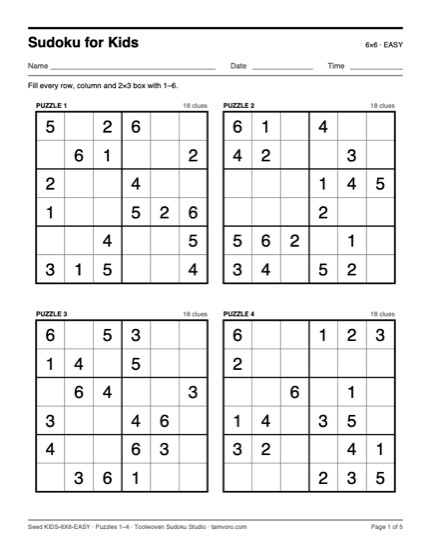
Next step
6×6 Easy · 12 puzzles
Digits 1–6 in six boxes of two rows by three columns. Half of the squares are filled in. The rectangular boxes are the new idea here, and the bold lines make them easy to see.
- Pages
- 5 (3 puzzle pages + 2 answer pages)
- Per page
- 4 puzzles
- Seed
KIDS-6X6-EASY
Ready for harder puzzles? These links open the maker with the grid size and level already chosen. Change the number of puzzles, the paper or the title, then download your own PDF with answers.
4×4 Medium 4×4 Hard 6×6 Medium 6×6 HardWhich size
Picking a grid for a child
Grid size matters more than level for young children. A bigger grid means more digits to keep in mind and more places to look, so move up one size at a time. The ages below are rough starting points, not rules.
| Grid | Digits and boxes | Typical starting age | Move up when… |
|---|---|---|---|
| 4×4 | 1–4 · four 2×2 boxes | about 4–7 | they finish 4×4 Hard (6 starting digits) without help |
| 6×6 | 1–6 · six 2×3 boxes | about 6–9 | 6×6 Hard feels easy, and they check rows, columns and boxes on their own |
| 9×9 | 1–9 · nine 3×3 boxes | from about 8–9 | start with 9×9 Easy on the puzzle maker or the large print PDFs |
Teaching
Explaining the rule
- One rule, said three ways. “Each row has 1, 2, 3 and 4 once. Each column has them once. Each thick box has them once.” For 6×6, the numbers go up to 6.
- Point, don’t tell. Put a finger on an empty square and ask which numbers are already in its row. Then its column. Then its box. The number nobody has used goes in.
- Pencil, not pen. Mistakes are part of it. An eraser keeps the sheet usable and the mood light.
- Check together. When a grid is full, read each row aloud. Hearing “1, 2, 3, 4” is the reward, and it catches mistakes before the answer page does.
- Stop while it is fun. One or two puzzles is plenty for a five-year-old. The Time line on the sheet is optional; many children enjoy beating their own time, others are happier without it.
Levels
What Easy, Medium and Hard mean
The level sets how many digits are printed at the start. On the maker’s sample of 60 puzzles per setting, a logic solver recorded the hardest step each one needed:
| Grid · level | Given digits | What it takes |
|---|---|---|
| 4×4 · Easy / Medium / Hard | 10 / 8 / 6 | All 180: “which number is missing?” |
| 6×6 · Easy | 18 | All 60: “which number is missing?” |
| 6×6 · Medium | 14 | 59 of 60 the same; 1 also needs “where can this digit go?” |
| 6×6 · Hard | 11–12 | 52 missing-number only, 7 also need “where can this digit go?”, 1 needs more advanced logic |
So 4×4 never needs more than the one idea, which is why it is the right place to start. All 24 puzzles in the two PDFs on this page needed only “which number is missing?”.
Classroom
Using the sheets with a group
- Same seed, same sheet. The seed is printed in the footer of every page. Give it to a colleague or a parent and they can rebuild the identical puzzles and answers in the maker.
- Differentiate quietly. Print the same grid size at Easy, Medium and Hard. The sheets look the same; only the number of starting digits changes.
- Early-finisher folder. Six 4×4 puzzles or four 6×6 puzzles per page fit a five- to ten-minute slot. Keep a stack of puzzle pages and one answer page per stack.
- Print the puzzles only. Answer pages always come last: pages 1–2 of the 4×4 PDF and pages 1–3 of the 6×6 PDF are the puzzles.
- Talk it through. Under a document camera, solve one grid aloud: “This row has 1, 3 and 4, so this square must be 2.” Naming the step is how the rule sticks. The main page has more classroom tips and solving strategies.
Permission
Free to print and copy
You may print and photocopy these puzzles for free at home, in classrooms and in libraries. You may not resell them.
- Print as many copies as you need, for individuals or groups.
- Do not sell the PDFs or the puzzles, alone or as part of a paid book, bundle or subscription.
- To share them online, please link to this page:
https://tamvoro.com/sudoku-for-kids
Checked
How the puzzles were made
- Both PDFs were built by this site’s own generator and PDF writer, the same code the puzzle maker runs in your browser, with the seeds shown above.
- While generating, a digit is removed only if the puzzle still has exactly one solution, and every finished puzzle was counted again: all 24 have one solution.
- The Letter and A4 files contain the same puzzles in the same order; only the page size changes.
Questions
Sudoku for kids FAQ
What age can children start Sudoku?
Many children can try a 4×4 Sudoku at about 4 to 7 once they recognise the numbers 1 to 4. 6×6 usually suits about 6 to 9, and the classic 9×9 grid from about 8 or 9. These are rough guides: move up when a child finishes the harder level of the current size without help.
Is 4×4 or 6×6 Sudoku better for beginners?
Start with 4×4. It uses only the digits 1 to 4 and four 2×2 boxes, so a child can see the whole puzzle at once. 6×6 adds two more digits and rectangular 2×3 boxes, which is a good second step before 9×9.
Are the answers included?
Yes. Each PDF has the puzzle pages first and the answer pages at the back. Print only the puzzle pages for children and keep the answers for yourself.
Do these puzzles have only one solution?
Yes. Every puzzle was checked by a solver that stops when it finds a second solution, so each grid has exactly one correct answer and children never have to guess.
Can I print them for my class?
Yes. You may print and photocopy the PDFs for free at home, in classrooms and in libraries. Please do not sell them.
How do I make harder Sudoku for kids?
Open the Sudoku maker with 4×4 or 6×6 selected and choose Medium or Hard. Harder levels print fewer starting digits. You can choose 1 to 60 puzzles, 1 to 6 per page, and turn answer pages on or off.